
Diplomatic Equality in a Segregated Capital
Segregation and Diplomatic Representation
African diplomats and visiting officials faced racial segregation in American restaurants and public facilities. Their complaints prompted apologies, protocol initiatives, and instructions to American diplomats on discussing racial discrimination in the United States with foreign audiences. [1] [3] [4] [8]
Refused Service and Public Protest
In October 1957, Ghanaian minister K. A. Gbedemah was refused service inside a Howard Johnson restaurant near Dover, Delaware, even after identifying himself. He publicized the incident. Three days later, he ate breakfast with President Dwight Eisenhower and Vice President Richard Nixon at the White House, where he also discussed the Volta River development project. Both the company and the American government apologized. [1]
Ambassador Wilson Flake reported from Accra that Kwame Nkrumah criticized Gbedemah for publicizing the episode and directed government media to stop covering it. State Department officials subsequently advised against sending a further presidential letter because they expected Gbedemah to make it public. In 1961, Sierra Leone’s William Fitzjohn made a different calculation after another refusal of service: he described the experience during a lecture but avoided an official dispute he feared might strain relations. [2] [3]
Equality or a Diplomatic Exception
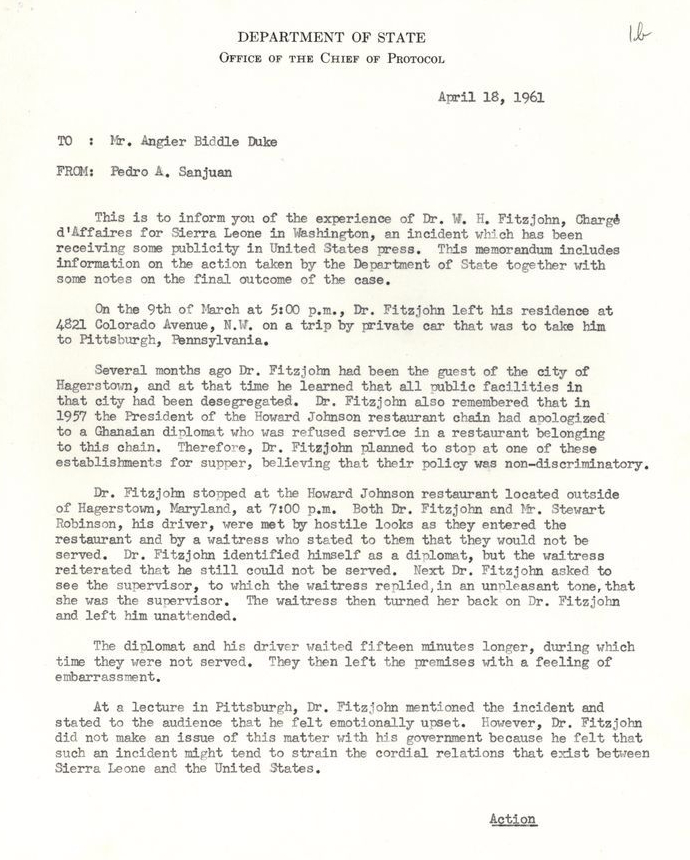
Traveling from Washington to Pittsburgh, Fitzjohn and his driver, Stewart Robinson, stopped near Hagerstown, Maryland. The restaurant refused them service despite his diplomatic identification. He had chosen the chain partly because he remembered its apology to a Ghanaian visitor in 1957 and believed local public facilities had been desegregated. [3]
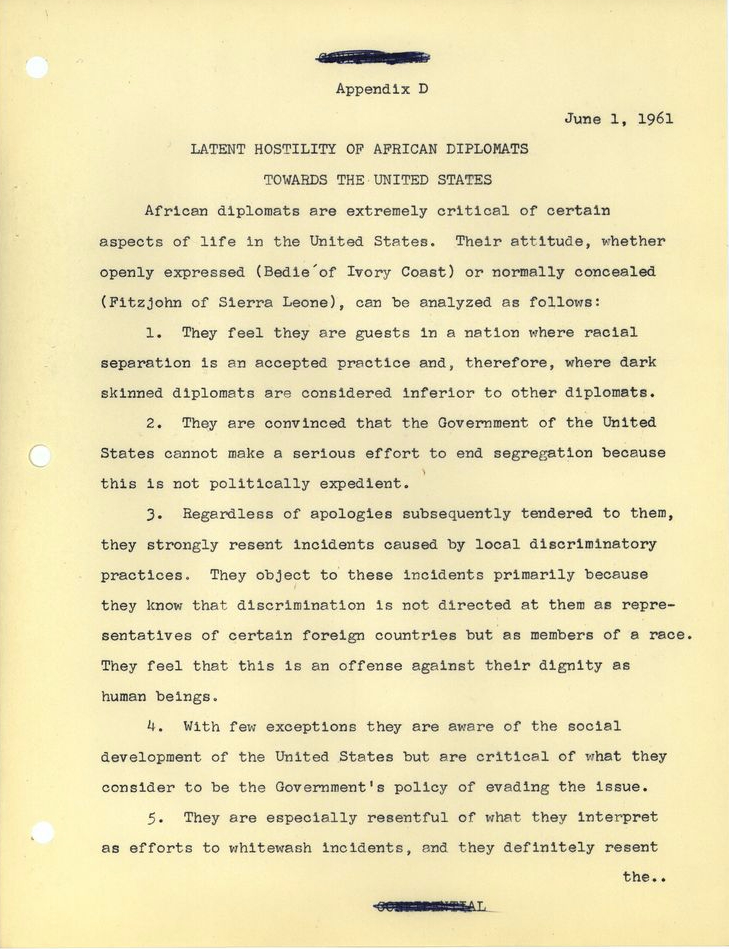
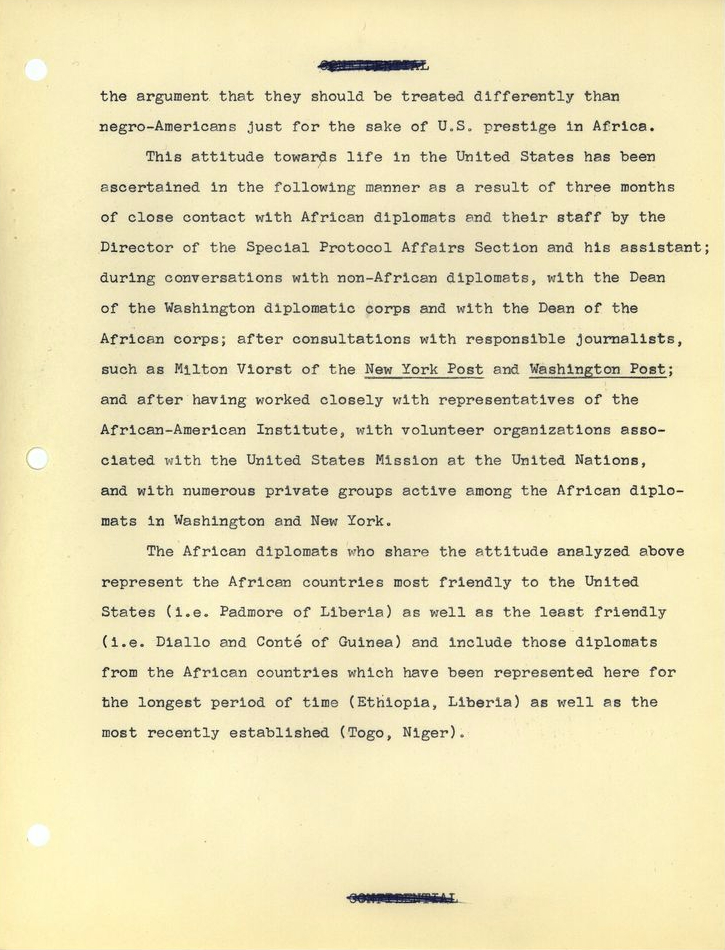
A June 1961 assessment in Pedro Sanjuan’s papers addressed the wider pattern. Officials reported that African diplomats experienced the humiliation as Black people as well as representatives of their governments. Their contacts included established missions such as Ethiopia and Liberia and newer arrivals such as Togo and Niger. They also reported resentment of a diplomatic exception that would grant foreign representatives privileges denied to Black Americans. [4] [5]
Federal Diplomacy and Local Resistance
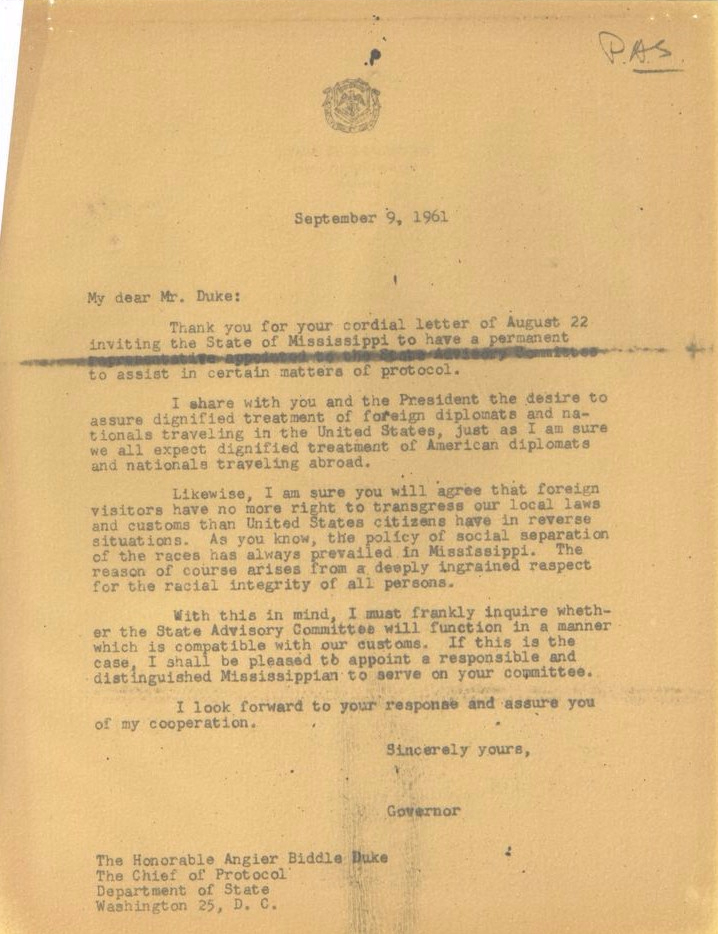
In September 1961, Mississippi governor Ross Barnett replied to Chief of Protocol Angier Biddle Duke’s proposal for a protocol advisory committee by defending segregation. Barnett endorsed dignified treatment for visitors but conditioned his participation on respect for local laws and customs. [6]
Sanjuan argued in 1963 for a permanent operational response. His Special Protocol Services office handled diplomats’ practical problems, legitimate American complaints against them, and cases requiring legal advice. He wanted that work separated from ceremonial protocol and placed under the under secretary. [7]
Explaining American Racism Abroad
A State Department circular prepared in June 1963 instructed American posts to address racial conflict candidly. It cited criticism at the African summit in Addis Ababa and acknowledged that explanations offered overseas could not replace action within the United States. Diplomats were to explain the administration’s commitments while recognizing the national problem. [8]
A General Right to Equal Service
The Civil Rights Act of 1964 changed the legal setting beyond the treatment of foreign representatives. Title II prohibited discrimination on grounds of race, colour, religion, or national origin in covered hotels, restaurants, and other public accommodations, and provided a route to civil enforcement. Its protections belonged to all persons covered by the law. Diplomatic complaints thus formed part of a broader history in which demands for special accommodation gave way to a general legal right to equal service. [9]
Further Reading
- Federal Democratic Republic of Ethiopia. Place the assessment’s reference to Ethiopia’s established diplomatic presence beside the history of Ethiopian representation in Washington. [5]
- Claiming Immunity: Staff, Courts, and Diplomatic Redress. Compare efforts to remedy discrimination with the separate problems of recognizing diplomatic privilege and obtaining redress for a mistreated representative. [3] [7]
Sources
- Department of State to the Embassy in Ghana, October 9, 1957
FRUS, 1955–1957, Africa, XVIII, document 130, paragraphs 1–4 and editorial footnotes 2–5; Central Files 845J.41/10–957
- Ambassador Wilson Flake to the Department of State, October 10, 1957
FRUS, 1955–1957, Africa, XVIII, document 131, pp. 380–381, paragraphs 2–6 and footnote 6; Central Files 845J.411/10–1057
- Pedro A. Sanjuan to Angier Biddle Duke, April 18, 1961
JFKPOF-124-003, digital page 5, first page of the memorandum, paragraphs 2–7
- Latent Hostility of African Diplomats Towards the United States, Appendix D, June 1, 1961, first page
Pedro A. Sanjuan Personal Papers, PASPP-001-019, digital page 32, Appendix D, points 1–5
- Latent Hostility of African Diplomats Towards the United States, Appendix D, June 1, 1961, continuation
Pedro A. Sanjuan Personal Papers, PASPP-001-019, digital page 33, continuation of point 5, method, and concluding paragraph
- Governor Ross Barnett to Chief of Protocol Angier Biddle Duke, September 9, 1961
White House Central Subject Files, JFKWHCSF-0365-001, digital page 23, paragraphs 2–4
- Pedro Sanjuan to Secretary of State Dean Rusk, July 8, 1963
FRUS, 1961–1963, XXV, document 298, pp. 656–657, paragraphs 2–9; NARA RG 59, Central Files 1960–63, ORG 8
- Department of State circular telegram 2177 to diplomatic and consular posts
FRUS, Public Diplomacy, VI, document 131, pp. 339–341, paragraphs 1–8 and footnotes 1–4; JFK Library, National Security Files, Subjects, box 295A, Civil Rights 6/19/63–7/9/63
- Civil Rights Act of 1964
Enrolled act of 2 July 1964, transcript of Title II, sections 201–204: covered public accommodations, prohibited discrimination, and civil enforcement.
Cite This Article
Diplomatic Equality in a Segregated Capital. Chanceries Diplopedia. Record version e4183056362a344d7e61.